
I just finished reading Being Mortal: Medicine & What Matters in the End, by Atul Gawande. His book, and all his writing I’ve read thus far, is both rich with research and elegant in its storytelling. Being Mortal is largely about how we grapple with mortality, both as people who will ourselves confront it at some point…and people who will likely have to journey alongside loved ones as they confront it. It’s a beautiful, raw, and important book.
I’ve been really stuck on a portion of the book towards the end, the irony of which is not lost on me (keep reading and you’ll see why). Gawande explains some research that led scientists to understand more clearly how humans both experience moments, and how they remember them. He writes about something called The Peak-End Rule. Essentially, the research shows that an individual’s overall impression of an experience, from something as consequential as surgery to something as commonplace as watching a sports game, is the average of the most intense moment (the “peak”, and this can be positive or negative) and the feeling they have at the end. Gawande writes,
“People seemed to have two different selves–an experiencing self who endures every moment equally and a remembering self who gives almost all the weight of judgment afterward to two single points in time, the worst moment and the last one. The remembering self seems to stick to the Peak-End rule even when the ending is an anomaly.”
So here’s what I’ve been thinking about: What implications does the Peak-End Rule have for my work with children? In my role as Division Head I deal mostly with problems. Rarely are faculty, children, or parents stopping in to chat about “That decision you made that I love!” or “That student who made a great choice!” or “That really great feeling I have about everything the school is doing!” Don’t get me wrong, there are plenty of positive moments and people do make efforts to share what’s going well. It’s just the exception rather than the rule. I don’t love that the feeling connoted with my role is that of “in trouble” (with both adults and children!). In fact, my husband tells me “In Trouble” should be the title of a book I write. Contrary to popular wish, I do not have a magic wand or a hidden easy button in my office that will remove, cure, or discipline away what is hard about growing up and learning. I did not get or take this job because my angry eyebrows and disappointed voice are stronger or more influential than yours. They aren’t.
What I do have is a deep, abiding, and passionately held belief that, as Ross Greene writes, “Children do well if they can.” If they can’t or aren’t, there’s always a whole lot more complexity to the why behind it than the angry eyebrows or disappointed voice would ever facilitate uncovering. In my role I have the privilege of trying every day to make decisions and act in a way that preserves and protects the dignity of each child. I am not in the business of “trouble.” Rather, I am in the business of assisting little humans through childhood. I’ve had a lot of intense, difficult moments with children and families in my years as a division head. There’s ones I’ve handled well, and moments I wish I could do-over. I’m encouraged by the Peak-End Rule and what it might mean for how children, particularly those for whom the rules and rituals of school do not come easily, ultimately walk away from their school experience feeling about themselves, about our school, and, yes, even about me. Gawande writes,
“In the end, people don’t view their life merely as the average of all its moments — which, after all, is mostly nothing much plus some sleep. For human beings, life is meaningful because it is a story. A story has a sense of a whole, and its arc is determined by the significant moments, the ones where something happens..we have purposes larger than ourselves. Unlike your experiencing self–which is absorbed in the moment–your remembering self is attempting to recognize not only the peaks of joy and valleys of misery, but also how the story works out as a whole. That is profoundly affected by how things ultimately turn out. Why would a football fan let a few flubbed minutes at the end of the game ruin three hours of bliss? Because a football game is a story. And in stories, endings matter.”
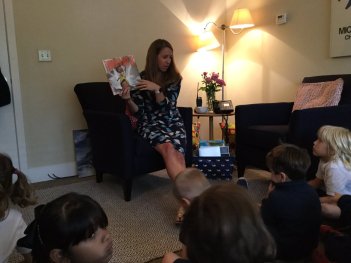 I hope the idea that Gawande is sharing, as it might pertain to education and growing up, means that when we’re in our hardest moments with a student, a family, a whole class, a colleague…that our Experiencing Self can acknowledge “Ouch, this is hard and it hurts,” but that we can also take comfort that the story continues, we haven’t arrived at the ending yet. And the reality that an ending remains unwritten is such a cause for hope! In fact, according to the Peak-End Rule, endings are so powerful they have the capacity to counter-balance even the hardest of journeys. Gawande finishes his reflections on the role of the Peak-End Rule in living, and in dying, by writing,
“I am leery of suggesting the idea that endings are controllable. No one ever really has control. Physics and biology and accident ultimately have their way in our lives. But the point is we are not helpless either. Courage is the strength to recognize both realities. We have room to act, to shape our stories.”
As an educator, I have the privilege to walk with each child and their family through this growing up journey. Our Experiencing Selves endure every moment of that journey equally, all the joyful highs and all the excruciating and confusing lows. The Peak-End Rule reminds me that it is, in fact, a journey. And as all great journeys do, childhood eventually comes to an end. It is my hope, with each child and family I walk with along the way, that when my involvement in the story comes to an end we’ll be able to look at each other with warmth and trust as we pass the reins to our Remembering Selves and cheer, “We made it!”

 K.I.S.S. (Keep It Simple, Schilly)