Adventure: Disconnecting to Connect

Tomorrow I am traveling internationally for the first time in five years. I am traveling internationally completely solo – not yet knowing anyone on the other end – for the first time ever.

I imagine the devil on one shoulder and the angel on the other both saying to each other: what is this introvert thinking?!

But I know I am going to have an adventure. And adventures, moments of disequilibrium, and newness are what move us to learn and see the world with fresh perspectives. Adventures are what bring inspiration and challenges that we face, learn from, and write on our memory as a story to be shared.

And what or who are we – child or adult – without our stories?

I look forward to writing more of my story in the next two weeks while skiing with a group of women at La Parva Ski Center in the Chilean Andes.  I am eager to learn more about the technical skills of backcountry skiing and freeriding. I am eager to learn more about the harder-to-nail-down skills of self-awareness, confidence, solitude, and making new friends.

I recently read this article by Gregoris Kalai in the Huffington Post about disconnecting in order to connect. That is my goal this trip: to disconnect from many of the devices and things I treasure and devote my time and attention to here. NOT in order to remain disconnected, but to connect more deeply with myself and with the world around me in a new way: that I might return to those connections refreshed and the next richer version of myself.

A Tale of Enduring Leadership – Part 4: The End

Fairwell Elephant Island

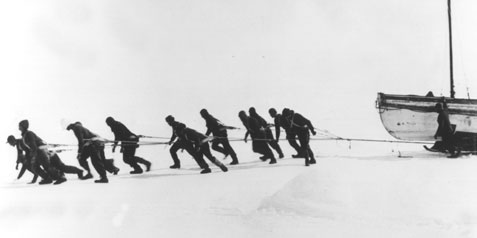
Ernest Shackleton and his crew of 27 set sail aboard the sturdy ship christened Endurance in December of 1914. Over the course of their two year expedition they truly lived everything embodied in the word “endurance”. Forced to abandon their ship, they spent months traveling hundreds of miles over frozen land and hellish seas, withstanding an astonishing amount of physical and mental hardship. Most astounding is that, in spite of all they endured, not a single member of the crew perished. Though they did not achieve the expedition’s goal of crossing Antarctica on foot, they achieved something that has gone down in history as a captivating tale of leadership, teamwork, and tenacious endurance. Shackleton’s initial transparency and consequent leadership attracted a group of like-minded individuals who he transformed as a result of presence, acknowledgement, and play into a true team able to endure and conquer challenges for the sake of their shared mission. In 21st century schools such leadership can grow communities that thrive in a constantly changing world as we strive to deliver our mission to each child.

A Tale of Enduring Leadership – Part 3: Play!

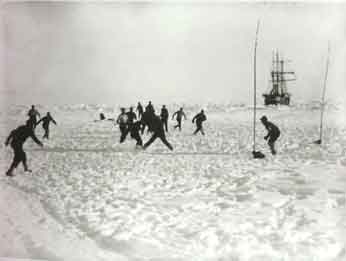
Football on the ice. (Photographer: Frank Hurley)

Football on the ice.
(Photographer: Frank Hurley)

Even in light of the grim forecast for the expedition’s hardships, Shackleton understood the importance of play and the value of morale. This photo shows members of Shackleton’s crew playing football. Their ship, slowly being crushed by the Antarctic ice, sits in the background. With cold temperatures, dwindling food supplies, winter nearing, the hours of darkness increasing everyday, and no end in sight it is marvelous that there was space to play. We live fast-paced, high-stimulus lives. As educators our attention is pulled a thousand ways at once, and yet we also strive to keep it focused on the one thing that really matters in our profession: children. It is so easy to get bogged down in the to-do lists of job and life, in the hard work of working hard…that we forget that play has a very important place in drawing us together, in lightening the heavy load, and in adjusting our perspective. Shackleton’s crew played cards, hockey, produced shows, performed music, sang, and shared company. As a result, Shackleton’s crew enjoyed camaraderie in the face of all manner of physical and mental trials. We must, as educators in the 21st century, strive to keep sacred our time to play together and on our own.

A Tale of Enduring Leadership – Part 2: Presence & Acknowledgment

Endurance_Shackletons_Lege

Shackleton was, from the start, disarmingly transparent about the work that would be required if the expedition was to succeed. He demolished traditional power structures of the time by requiring all members of his crew, including himself, to conduct their fair share of chores and duties. Shackleton never put himself in a position where himself or his role could be construed as more worthwhile to the expedition than any other’s. After they were forced to abandon their ship Shackleton threw his name in the lot for the few sealskin sleeping bags that were available, as there were too few for everyone to have one. His job was leader, and that did not automatically entitle him to creature comforts at the expense of his crew. Shackleton believed in the power of presence, of participation in the daily life of the crew. Their work was not beneath him, it was essential to the common goal they all shared: the success of the expedition. Too often school leaders manage and direct from above and outside, and too quickly lose touch with details of the important work that happens with children on a daily basis in classrooms and hallways, at recess and lunch, and in partnership with families. These places and moments where children are is why schools exist, and a leader’s participation in them furthers the success of the common goal we all share: the growth of children into healthy and happy adults. In order to lead, you must be intimately and dependably present.

Shackleton knew the power of acknowledging people for who they are and what they bring to the table. He received over 5,000 applications for his expedition. Shackleton passed up far more qualified individuals for those who he believed had the character, skill set, and certain “je ne sais quois” he was looking for. Records report him selecting people who could sing, play the banjo, or answer his sometimes unusual questions in a manner that pleased him. Shackleton understood that to see these other corners of people, to recognize them and name them as valuable and worthy, would strengthen his crew. His team was comprised not of skills but of whole people whose whole selves (including their less typically “seaworthy” talents) were known, acknowledged, and celebrated. As educators we know from working with children that to truly see them, to invest in recognizing their presence and accomplishments in meaningful and authentic ways, creates a powerful connection and a willingness to take risks. When an authority figure (whether teacher, administrator, or expedition leader) acknowledges you in this way, you know you are safe to be, safe to try, and safe to fail. You can truly throw yourself on board with the mission (of school or expedition), because you know that you will not be dismissed, devalued, or ignored. The effort to learn about and acknowledge the gifts of ourselves and each other knits communities of all types together.

A Tale of Enduring Leadership – Part 1

shackleton-2

“Men Wanted: For hazardous journey. Small wages, bitter cold, long months of complete darkness, constant danger, safe return doubtful. Honour and recognition in case of success.” – Ernest Shackleton

Ernest Shackleton wrote the above text for an advertisement placed for his 1914 expedition to cross Antarctica via the South Pole on foot. Shackleton had clarity of mission and transparency in his communication because he was certain about what motivated him – as man and as leader. As a result, his advertisement for an uncomfortable, life-threatening, and arduous journey attracted people to his team who signed on neither for themselves (for they were promised nothing but discomfort and loss) nor for Shackleton (for they did not yet know him). They responded because they operated from the same core reasons for living – even, if not especially, in the face of formidable challenge. Much has been written on Ernest Shackleton and the lessons his 1914 voyage of the Endurance provides about leadership. As an educational leader in the 21st century, Shackleton’s clarity of mission and three qualities of his leadership have rooted themselves in me professionally and personally. They are presence, acknowledgement, and play.  The power and importance of them transcend time and space: they are enduringly relevant and necessary for leaders, faculty, families, and most important of all, the children we serve.

What is “healthy”, anyway?

I have been thinking a lot lately about how early it happens that girls acquire a perception of their own worth. Children – both boys and girls – are bombarded by messages from the media, remarks from women in their lives about their own self-images (“Oh, no thank you! Just a salad a for me. That _____ will go straight to my hips.”), and by young adults that they look up to and model their lives after (the 95lb, 5’5″ fourteen year old who says on the bus to school “Ugh. I feel so fat today.”) Since young children are still, in so many ways, very much children…it can be easy to think that they aren’t absorbing these things like sponges. We assume that girls are not acquiring an unachievable vision of what they should look like, and that boys are not inheriting the same vision for themselves and for the women these girls will grow up to be.

Kate Thompson in The Huffington Post recently published an article (read it here)  on this very topic. One of the most striking excerpts:

“In this beautifully written and very moving article Passing on Body Hatred by Kasey Edwards, we can see how the cycle so often begins in childhood. After her mother had shared her feelings of negative body image with her as a child, she said, in an open letter to her mother: “I cursed you for feeling so unattractive, insecure and unworthy; because, as my first and most influential role model, you taught me to believe the same thing about myself.” ….Women are the mothers, wives, daughters, doctors, scientists and thinkers of the future. Our greatest contribution to the world is not about how we look but who we are and what we do.”

In a similar vein, an old friend of mine recently wrote a piece describing her own struggle with body-image and beauty in the high-powered world of Hollywood . I am grateful that there are strong, independent female role-models like Tara Rasmus out there in the “real world” who can write pieces like this and remind young women (indeed, all of us) that the media portrayal of femininity is artificial and empty. As educators we need to remember that we send subtle, yet palpable, messages to the young children in our classrooms everyday. In how we accept compliments, care for ourselves, speak about body-image, model healthy-eating…we too bear a heavy responsibility in creating a culture for boys and girls that values healthy choices in which that word “healthy” is known for more than lettuce, self-denial, or compulsive exercising. I am far more inclined to champion this view of healthy that Tara referred to in her article:

“Sexy is inherent in a healthy appreciation for food, in having the energy to romp with your beloved, pick up your baby, cook dinner for your friends, go for a run, or simply take a gentle walk to the market. Sexy is in feeling sated, having options, and feeling alive.” – Sophie Dahl