Read this insightful and thought provoking article on six words you should say today.
Do you ever watch children play, compete, work, try again….and just enjoy what you have the chance to witness?

Read this insightful and thought provoking article on six words you should say today.
Do you ever watch children play, compete, work, try again….and just enjoy what you have the chance to witness?
“One lives but once in this world.” – Johann von Goethe
PowderQuest’s Ingrid Backstrom Women’s Freeride Camp, 2013
August 2-9
La Parva, Chile
Photos courtsey of: Colleen Schilly, Margaret Meyer, Roberta Rebori, & David Owen

I have written at least eight different blog posts in my head reflecting on my recent experience skiing in the Chilean Andes, but this one today honors the beauty of how adventure – and the challenges and triumphs resulting from it – can connect to your everyday professional and personal life.
As I met with a colleague this morning we discussed hopes and anxieties for the year ahead. It quickly became an interesting discussion on the role of fear, which can either paralyze & consume you or fuel your change and growth. We discussed whether or not communicating about nervousness and fears was worthwhile or counterproductive. Similarly, we moved into a discussion about support and professional growth and how to accept both compliments and constructive feedback with grace and confidence. In both these conversations I found myself having one of those classic light bulb “A-HA!” style moments and sharing anecdotes from my recent skiing experience with PowderQuest.
Fear – Work With & Through It
It was not until halfway through my trip that my trip-mates and guides knew that I had never been off-piste skiing before. I was not actively trying to hide this information, but neither did I volunteer it. I stood at the top of varying levels of backcountry chutes and bowls with fear pounding in my chest. And I held that alone. I don’t think that made me brave. It made me isolated. It wasn’t until a particularly long and harrowing day that I finally said “I have never done this before, I am terrified.” It was only then that the women on the trip were able to more fully be the amazing women they are in support of me. It was only then that Ingrid Backstrom & Leah Evans could really put their expertise and coaching talent to maximal use. I was able to get the help I needed to become a better, braver skier because I wasn’t trying to hide what was going on inside. In our professional and personal lives I think we tend to connote fear with cowardice. Fear is neither brave nor cowardly. Fear is a rationale response to risk, to uncertainty, to the new. Whether you are standing at the cusp of a narrow snow-covered chute flanked by rocks or on the cusp of a new job, a changing relationship, or something else big or small….I am more certain then ever that if you find the right people to share your fear with that you will find yourself capable of more than you imagined.
Spanish Sausage – Love It & Yourself
Midway through our trip, Leah & Ingrid turned to our group of beautiful, smart, talented, and successful skier chicks who were ripping up the slopes and made the following pronouncement:
“Here’s the deal. For the rest of the day if you say anything negative about your skiing or yourself you have to stop at the entrance to the lift, raise your hands in the air, do a dance, and yell ‘ME GUSTA LA LONGANIZA CHILENA!”
Meaning, “I LOVE CHILEAN SAUSAGE!” This certainly gave the lift operators a good chuckle. Many of us had to do this, sometimes multiple times, and even our superstar guides Ingrid & Leah were not exempt…going to show the pervasive problem we (and I think particularly women) have with two things:
Sure, some people will compliment you in order to wound you. Some people will give feedback that is not constructive and leaves you feeling scraped out inside. But we all know how to differentiate between THOSE people and the allies and supporters around us who mean what they say.
So….whether on a ski slope, in your office, or at home….WHAT IF?
What if we chose to live with our fear instead fighting the impossible fight to live without it?
What if we chose to let fear propel us to new heights alongside those who can champion us along the way?
What if we chose to accept gratitude and compliments with a smile and earnest thanks?
What if we chose to hear feedback with an open mind and heart rather than disappointment and self-criticism?
What could we then be capable of – independently and together?
Tomorrow I am traveling internationally for the first time in five years. I am traveling internationally completely solo – not yet knowing anyone on the other end – for the first time ever.
I imagine the devil on one shoulder and the angel on the other both saying to each other: what is this introvert thinking?!
But I know I am going to have an adventure. And adventures, moments of disequilibrium, and newness are what move us to learn and see the world with fresh perspectives. Adventures are what bring inspiration and challenges that we face, learn from, and write on our memory as a story to be shared.
And what or who are we – child or adult – without our stories?
I look forward to writing more of my story in the next two weeks while skiing with a group of women at La Parva Ski Center in the Chilean Andes. I am eager to learn more about the technical skills of backcountry skiing and freeriding. I am eager to learn more about the harder-to-nail-down skills of self-awareness, confidence, solitude, and making new friends.
I recently read this article by Gregoris Kalai in the Huffington Post about disconnecting in order to connect. That is my goal this trip: to disconnect from many of the devices and things I treasure and devote my time and attention to here. NOT in order to remain disconnected, but to connect more deeply with myself and with the world around me in a new way: that I might return to those connections refreshed and the next richer version of myself.

Ernest Shackleton and his crew of 27 set sail aboard the sturdy ship christened Endurance in December of 1914. Over the course of their two year expedition they truly lived everything embodied in the word “endurance”. Forced to abandon their ship, they spent months traveling hundreds of miles over frozen land and hellish seas, withstanding an astonishing amount of physical and mental hardship. Most astounding is that, in spite of all they endured, not a single member of the crew perished. Though they did not achieve the expedition’s goal of crossing Antarctica on foot, they achieved something that has gone down in history as a captivating tale of leadership, teamwork, and tenacious endurance. Shackleton’s initial transparency and consequent leadership attracted a group of like-minded individuals who he transformed as a result of presence, acknowledgement, and play into a true team able to endure and conquer challenges for the sake of their shared mission. In 21st century schools such leadership can grow communities that thrive in a constantly changing world as we strive to deliver our mission to each child.
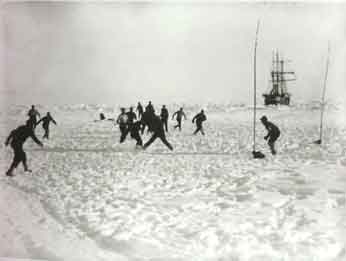
Football on the ice.
(Photographer: Frank Hurley)
Even in light of the grim forecast for the expedition’s hardships, Shackleton understood the importance of play and the value of morale. This photo shows members of Shackleton’s crew playing football. Their ship, slowly being crushed by the Antarctic ice, sits in the background. With cold temperatures, dwindling food supplies, winter nearing, the hours of darkness increasing everyday, and no end in sight it is marvelous that there was space to play. We live fast-paced, high-stimulus lives. As educators our attention is pulled a thousand ways at once, and yet we also strive to keep it focused on the one thing that really matters in our profession: children. It is so easy to get bogged down in the to-do lists of job and life, in the hard work of working hard…that we forget that play has a very important place in drawing us together, in lightening the heavy load, and in adjusting our perspective. Shackleton’s crew played cards, hockey, produced shows, performed music, sang, and shared company. As a result, Shackleton’s crew enjoyed camaraderie in the face of all manner of physical and mental trials. We must, as educators in the 21st century, strive to keep sacred our time to play together and on our own.
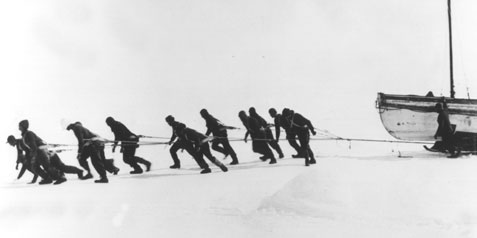
Shackleton was, from the start, disarmingly transparent about the work that would be required if the expedition was to succeed. He demolished traditional power structures of the time by requiring all members of his crew, including himself, to conduct their fair share of chores and duties. Shackleton never put himself in a position where himself or his role could be construed as more worthwhile to the expedition than any other’s. After they were forced to abandon their ship Shackleton threw his name in the lot for the few sealskin sleeping bags that were available, as there were too few for everyone to have one. His job was leader, and that did not automatically entitle him to creature comforts at the expense of his crew. Shackleton believed in the power of presence, of participation in the daily life of the crew. Their work was not beneath him, it was essential to the common goal they all shared: the success of the expedition. Too often school leaders manage and direct from above and outside, and too quickly lose touch with details of the important work that happens with children on a daily basis in classrooms and hallways, at recess and lunch, and in partnership with families. These places and moments where children are is why schools exist, and a leader’s participation in them furthers the success of the common goal we all share: the growth of children into healthy and happy adults. In order to lead, you must be intimately and dependably present.
Shackleton knew the power of acknowledging people for who they are and what they bring to the table. He received over 5,000 applications for his expedition. Shackleton passed up far more qualified individuals for those who he believed had the character, skill set, and certain “je ne sais quois” he was looking for. Records report him selecting people who could sing, play the banjo, or answer his sometimes unusual questions in a manner that pleased him. Shackleton understood that to see these other corners of people, to recognize them and name them as valuable and worthy, would strengthen his crew. His team was comprised not of skills but of whole people whose whole selves (including their less typically “seaworthy” talents) were known, acknowledged, and celebrated. As educators we know from working with children that to truly see them, to invest in recognizing their presence and accomplishments in meaningful and authentic ways, creates a powerful connection and a willingness to take risks. When an authority figure (whether teacher, administrator, or expedition leader) acknowledges you in this way, you know you are safe to be, safe to try, and safe to fail. You can truly throw yourself on board with the mission (of school or expedition), because you know that you will not be dismissed, devalued, or ignored. The effort to learn about and acknowledge the gifts of ourselves and each other knits communities of all types together.

“Men Wanted: For hazardous journey. Small wages, bitter cold, long months of complete darkness, constant danger, safe return doubtful. Honour and recognition in case of success.” – Ernest Shackleton
Ernest Shackleton wrote the above text for an advertisement placed for his 1914 expedition to cross Antarctica via the South Pole on foot. Shackleton had clarity of mission and transparency in his communication because he was certain about what motivated him – as man and as leader. As a result, his advertisement for an uncomfortable, life-threatening, and arduous journey attracted people to his team who signed on neither for themselves (for they were promised nothing but discomfort and loss) nor for Shackleton (for they did not yet know him). They responded because they operated from the same core reasons for living – even, if not especially, in the face of formidable challenge. Much has been written on Ernest Shackleton and the lessons his 1914 voyage of the Endurance provides about leadership. As an educational leader in the 21st century, Shackleton’s clarity of mission and three qualities of his leadership have rooted themselves in me professionally and personally. They are presence, acknowledgement, and play. The power and importance of them transcend time and space: they are enduringly relevant and necessary for leaders, faculty, families, and most important of all, the children we serve.

Read HERE to learn about the service learning project third graders implemented this year in connection with students at a school in Moblomong, South Africa. As with many projects in life, results are sometimes immediate and sometimes they take time to take tangible shape. We just recently received photos and letters from children who attend the school in Mablomong sharing images and stories of the books they are now enjoying.
One of the most moving elements of a service learning project such as this is that impact and growth is experienced on both sides of the shared connection. Today children reflected on some of the things they read and saw, recognizing both extreme differences and comforting similarities between things as simple as individual’s names, favorite foods, siblings, favorite activities, and feelings about school to realities as complex as lifestyles, family structure, and living conditions.
“No one knows everything. But together, we know a whole lot. This is the reason the Why community exists – to bring people together to listen, to speak, to give, to take…to share.” – Simon Sinek
Despite the constantly evolving world of education, the common connotations of school are still pencils, rulers, notebooks, reading, writing, arithmetic, etc. From desks to markers, raised hands to A+ stickers….the traditional perception of school in media remains unchanged. A quick Google Image search of the word “school” yields pages of images with school buses, stacks of textbooks, pencils, chalkboards, apples, and quaint one-room schoolhouses.
When asked, “What do you teach?” most teachers will reply with a subject…or a grade level (for which the follow up question is often “So what subjects does that include?”) What remains largely unacknowledged is the “subject” that gives reading, history, writing, math, science, etc. their life, their opportunity to be studied and absorbed at all.
Social-emotional learning is the process by which we develop the life skills of dealing with oneself, others in various relationships, and our work in an effective manner.
On any given school day, a typical content-area of learning may or may not happen (no math today!)….but social-emotional learning happens no matter what. All day. Every day. Value the adults, teachers, coaches, etc. in children’s lives who make conscious, reflective, and growth-minded effort to make transparent the social-emotional curriculum and know the importance of growing students who are skilled mathematicians, readers, writers, historians, and scientists….and who recognize that these skills are all the more powerful, accessible, and applicable when students are also grown to be collaborative, self-aware, relational decision-makers for themselves and their community. Watch this short video from Edutopia to learn more.

 K.I.S.S. (Keep It Simple, Schilly)