A Tale of Enduring Leadership – Part 2: Presence & Acknowledgment

Endurance_Shackletons_Lege

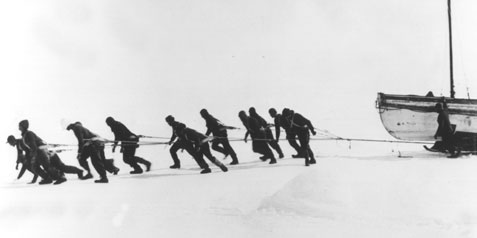
Shackleton was, from the start, disarmingly transparent about the work that would be required if the expedition was to succeed. He demolished traditional power structures of the time by requiring all members of his crew, including himself, to conduct their fair share of chores and duties. Shackleton never put himself in a position where himself or his role could be construed as more worthwhile to the expedition than any other’s. After they were forced to abandon their ship Shackleton threw his name in the lot for the few sealskin sleeping bags that were available, as there were too few for everyone to have one. His job was leader, and that did not automatically entitle him to creature comforts at the expense of his crew. Shackleton believed in the power of presence, of participation in the daily life of the crew. Their work was not beneath him, it was essential to the common goal they all shared: the success of the expedition. Too often school leaders manage and direct from above and outside, and too quickly lose touch with details of the important work that happens with children on a daily basis in classrooms and hallways, at recess and lunch, and in partnership with families. These places and moments where children are is why schools exist, and a leader’s participation in them furthers the success of the common goal we all share: the growth of children into healthy and happy adults. In order to lead, you must be intimately and dependably present.

Shackleton knew the power of acknowledging people for who they are and what they bring to the table. He received over 5,000 applications for his expedition. Shackleton passed up far more qualified individuals for those who he believed had the character, skill set, and certain “je ne sais quois” he was looking for. Records report him selecting people who could sing, play the banjo, or answer his sometimes unusual questions in a manner that pleased him. Shackleton understood that to see these other corners of people, to recognize them and name them as valuable and worthy, would strengthen his crew. His team was comprised not of skills but of whole people whose whole selves (including their less typically “seaworthy” talents) were known, acknowledged, and celebrated. As educators we know from working with children that to truly see them, to invest in recognizing their presence and accomplishments in meaningful and authentic ways, creates a powerful connection and a willingness to take risks. When an authority figure (whether teacher, administrator, or expedition leader) acknowledges you in this way, you know you are safe to be, safe to try, and safe to fail. You can truly throw yourself on board with the mission (of school or expedition), because you know that you will not be dismissed, devalued, or ignored. The effort to learn about and acknowledge the gifts of ourselves and each other knits communities of all types together.

A Tale of Enduring Leadership – Part 1

shackleton-2

“Men Wanted: For hazardous journey. Small wages, bitter cold, long months of complete darkness, constant danger, safe return doubtful. Honour and recognition in case of success.” – Ernest Shackleton

Ernest Shackleton wrote the above text for an advertisement placed for his 1914 expedition to cross Antarctica via the South Pole on foot. Shackleton had clarity of mission and transparency in his communication because he was certain about what motivated him – as man and as leader. As a result, his advertisement for an uncomfortable, life-threatening, and arduous journey attracted people to his team who signed on neither for themselves (for they were promised nothing but discomfort and loss) nor for Shackleton (for they did not yet know him). They responded because they operated from the same core reasons for living – even, if not especially, in the face of formidable challenge. Much has been written on Ernest Shackleton and the lessons his 1914 voyage of the Endurance provides about leadership. As an educational leader in the 21st century, Shackleton’s clarity of mission and three qualities of his leadership have rooted themselves in me professionally and personally. They are presence, acknowledgement, and play.  The power and importance of them transcend time and space: they are enduringly relevant and necessary for leaders, faculty, families, and most important of all, the children we serve.

What is “healthy”, anyway?

I have been thinking a lot lately about how early it happens that girls acquire a perception of their own worth. Children – both boys and girls – are bombarded by messages from the media, remarks from women in their lives about their own self-images (“Oh, no thank you! Just a salad a for me. That _____ will go straight to my hips.”), and by young adults that they look up to and model their lives after (the 95lb, 5’5″ fourteen year old who says on the bus to school “Ugh. I feel so fat today.”) Since young children are still, in so many ways, very much children…it can be easy to think that they aren’t absorbing these things like sponges. We assume that girls are not acquiring an unachievable vision of what they should look like, and that boys are not inheriting the same vision for themselves and for the women these girls will grow up to be.

Kate Thompson in The Huffington Post recently published an article (read it here)  on this very topic. One of the most striking excerpts:

“In this beautifully written and very moving article Passing on Body Hatred by Kasey Edwards, we can see how the cycle so often begins in childhood. After her mother had shared her feelings of negative body image with her as a child, she said, in an open letter to her mother: “I cursed you for feeling so unattractive, insecure and unworthy; because, as my first and most influential role model, you taught me to believe the same thing about myself.” ….Women are the mothers, wives, daughters, doctors, scientists and thinkers of the future. Our greatest contribution to the world is not about how we look but who we are and what we do.”

In a similar vein, an old friend of mine recently wrote a piece describing her own struggle with body-image and beauty in the high-powered world of Hollywood . I am grateful that there are strong, independent female role-models like Tara Rasmus out there in the “real world” who can write pieces like this and remind young women (indeed, all of us) that the media portrayal of femininity is artificial and empty. As educators we need to remember that we send subtle, yet palpable, messages to the young children in our classrooms everyday. In how we accept compliments, care for ourselves, speak about body-image, model healthy-eating…we too bear a heavy responsibility in creating a culture for boys and girls that values healthy choices in which that word “healthy” is known for more than lettuce, self-denial, or compulsive exercising. I am far more inclined to champion this view of healthy that Tara referred to in her article:

“Sexy is inherent in a healthy appreciation for food, in having the energy to romp with your beloved, pick up your baby, cook dinner for your friends, go for a run, or simply take a gentle walk to the market. Sexy is in feeling sated, having options, and feeling alive.” – Sophie Dahl

Coins Made Change!

P1000707

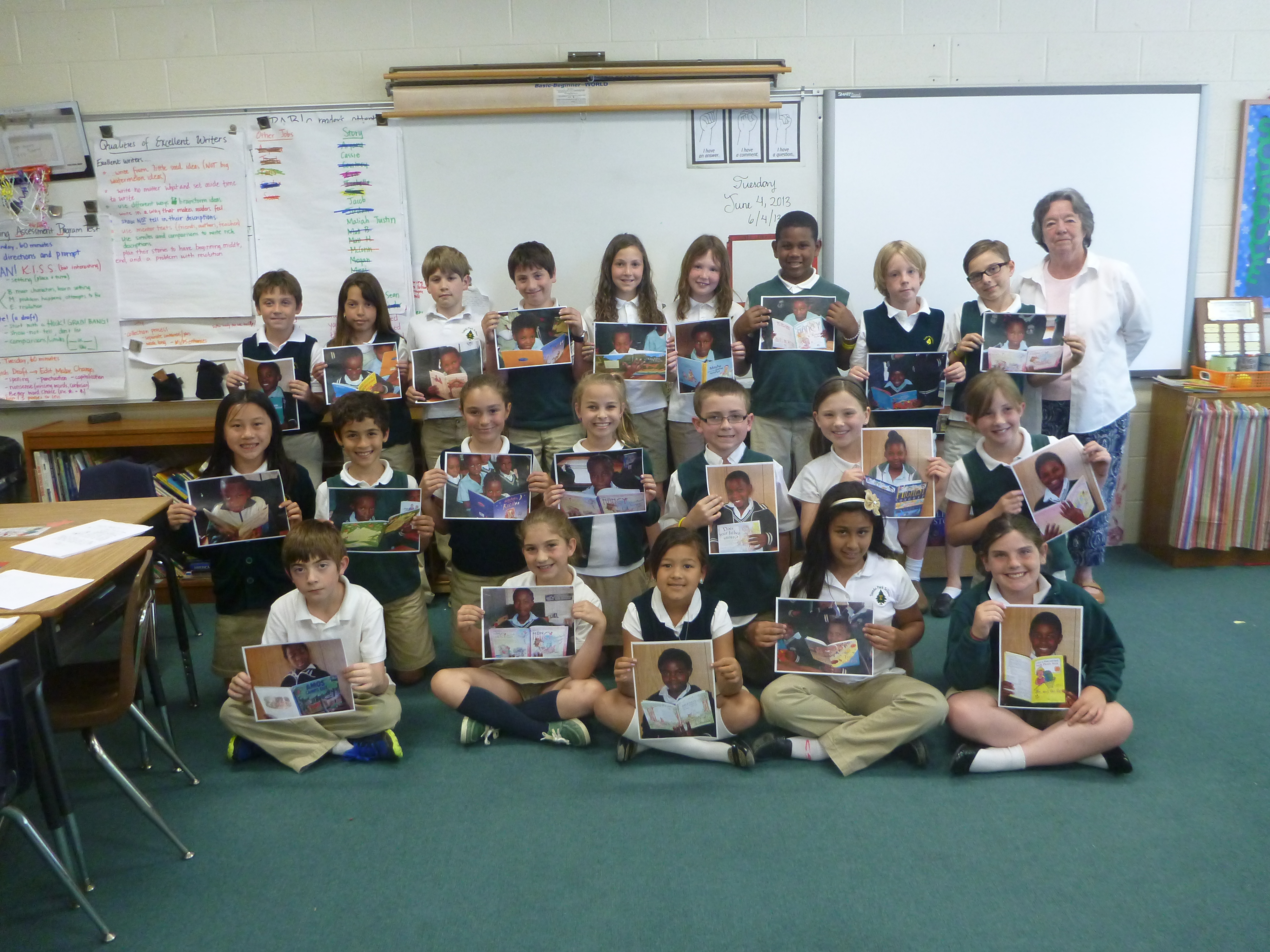
Read HERE to learn about the service learning project third graders implemented this year in connection with students at a school in Moblomong, South Africa. As with many projects in life, results are sometimes immediate and sometimes they take time to take tangible shape. We just recently received photos and letters from children who attend the school in Mablomong sharing images and stories of the books they are now enjoying.

One of the most moving elements of a service learning project such as this is that impact and growth is experienced on both sides of the shared connection. Today children reflected on some of the things they read and saw, recognizing both extreme differences and comforting similarities between things as simple as individual’s names, favorite foods, siblings, favorite activities, and feelings about school to realities as complex as lifestyles, family structure, and living conditions.

“No one knows everything. But together, we know a whole lot. This is the reason the Why community exists – to bring people together to listen, to speak, to give, to take…to share.” – Simon Sinek

The Rainbow Won’t Wait

Photo by Maddie McManus

Photo by Maddie McManus

I think these words are useful to keep at the forefront of our minds as we head into the homestretch together:

“The work can wait while you show the child the rainbow, but the rainbow won’t wait while you do the work. ” -Patricia Clafford

Whether it is actually a rainbow, or whether the rainbow here represents a millipede, a dropped hot dog, an untied shoelace, the need for a hug, or a conversation to help sort out a challenge…….these teachable moments and memory-making experiences are fleeting and yet can make deep impact. It’s easy to miss them in the last chaotic weeks of school. Stay tuned. To each other and to children. The rainbows are worth pausing and absorbing…because the work will be there when we return.

The Air the “3 Rs” Breathe

Despite the constantly evolving world of education, the common connotations of school are still pencils, rulers, notebooks, reading, writing, arithmetic, etc. From desks to markers, raised hands to A+ stickers….the traditional perception of school in media remains unchanged. A quick Google Image search of the word “school” yields pages of images with school buses, stacks of textbooks, pencils, chalkboards, apples, and quaint one-room schoolhouses.

When asked, “What do you teach?” most teachers will reply with a subject…or a grade level (for which the follow up question is often “So what subjects does that include?”) What remains largely unacknowledged is the “subject” that gives reading, history, writing, math, science, etc. their life, their opportunity to be studied and absorbed at all.

Social-emotional learning is the process by which we develop the life skills of dealing with oneself, others in various relationships, and our work in an effective manner.

On any given school day, a typical content-area of learning may or may not happen (no math today!)….but social-emotional learning happens no matter what. All day. Every day. Value the adults, teachers, coaches, etc. in children’s lives who make conscious, reflective, and growth-minded effort to make transparent the social-emotional curriculum and know the importance of growing students who are skilled mathematicians, readers, writers, historians, and scientists….and who recognize that these skills are all the more powerful, accessible, and applicable when students are also grown to be collaborative, self-aware, relational decision-makers for themselves and their community. Watch this short video from Edutopia to learn more.

If…then…

“The clear fact of everyday experience is that human intelligence is diverse and multi-faceted. For evidence, we need only look at the extraordinary richness and complexity of human culture and achievement. But the foundation of all these achievements is a unique, personal aptitude combined with a deep passion and commitment.” – Ken Robinson

IF we are truly interested in creating a school culture that is inclusive of many intelligences…
IF we believe that one size does not fit all children (a belief we can hold even when we are limited in what sizes we can fully accommodate)…
IF we hold that  a child in our school deserves to believe they have distinctive value and worth…
IF we trust that taking safe risks is necessary for children’s growth and development…
and
IF we know that children need modeling and transparency to set them up for their best chance at success in these risks…

THEN we need to start by naming and including our intelligences in that school culture
THEN we must recognize that our strengths, passions, intelligences come in different sizes, shapes, colors, and complexities.
THEN we will believe in our own distinctive value and worth to this community, and be willing to see and acknowledge it in our colleagues.
THEN we can take our own safe risks for our own growth and development.
And
THEN we have, as the decision-makers and weather-creators of their daily school environment, a confident, flexible, and unapologetic answer to the question “How are you intelligent?” about ourselves.

It is easy to spend our days feeling weighed down by our struggles and challenges, by the things that go “wrong”. We forget that some of the core things children need for happiness and health are not their needs because they are CHILDREN, but because they are PEOPLE….and we as adults need them too. We need to allow ourselves to accept the reality that our weaknesses and challenges do not define us or our worth. We need to know and be willing to articulate for others our strengths and passions so that they can serve as springboards for new growth. We need to be seen and recognized. We need to contribute and to have a voice. There are many things we each bring to the table – for the sake of our students and our community – and some of those things we know about each other, and some of them we don’t. How are you intelligent? Who you are is valuable to children and to your school. What do you bring to the table?

Are great coders today’s rock stars?

A parent of one of my students shared this video with me. Regardless of your familiarity with programming or your comfort with technology it is hard to deny that the shape of our society and culture is changing as a result of computers. How should schools change in response? What should they preserve apart from technological tools that is meaningful and valuable? These are important questions without clear answers. Though this video champions the importance of learning to code and program, it does highlight some important points:

  • Computers are prolific in our society and learning how to make them do things (programming & coding) is increasingly relevant.
  • Great and influential programmers (indeed great and influential ANYBODYs) are born from a simple spark (i.e. making a word appear on the screen as a result of code you wrote). Providing students with the opportunity to experience that spark (whether in programming or other skills) can set them on a path to a lifetime of engagement and fulfillment in a profession that truly captures their imagination.
  • Great inventions are borne of the freedom to imagine and the motivation and exposure to tools that allows progress between idea and product
  • There is an increasingly small gap between the words “creative” and “computer engineering/programming”. The former used to be reserved for more “right brain” qualities of fine or performing arts and the latter reserved for the more “left brain” qualities of maths and sciences. In the 21st century creativity is more and more associated with innovative mindset towards varied resources and tools and what a learner can DO with what is around them to effect meaningful change on their community.

It’s not you. It’s February.

Winter doldrums anyone? It’s not you, it’s February. The wack-a-doo month with too few days that feels too long and can’t make up its mind about what season it’s in and acts like every day is Monday. Blame it on February.

That said, I ran across Pat Bassett’s article in the most recent issue of Independent School called “Twenty-five Factors Great Teachers Have in Common”. It’s terrific…and short. Perfect for February.

  • Teachers, here is my only demand as you read it: Read it like a mirror (reflecting back to you the hallmarks of your great-teacher-ness) NOT a to-do list (of things you are expected to do better).
  • GreatTeachers2Non-teachers, here is my only demand if you read it: Thank a teacher. As Pat Bassett says, “Great teachers don’t need encomiums of praise.” They do, however, appreciate it. Especially in February.

If February has its hold on you too strongly to take a moment to read it…The image is one I created of the verbs that start the qualities of great teachers from Bassett’s article – I find these verbs exemplify not just great teachers, but great people. If all you do is hold onto ONE of these, perhaps it can turn a grey-sky case of the Februaries into a blue-sky bit of bounce in your step…for you and the children in our lives.

Counting on Change in 3rd Grade

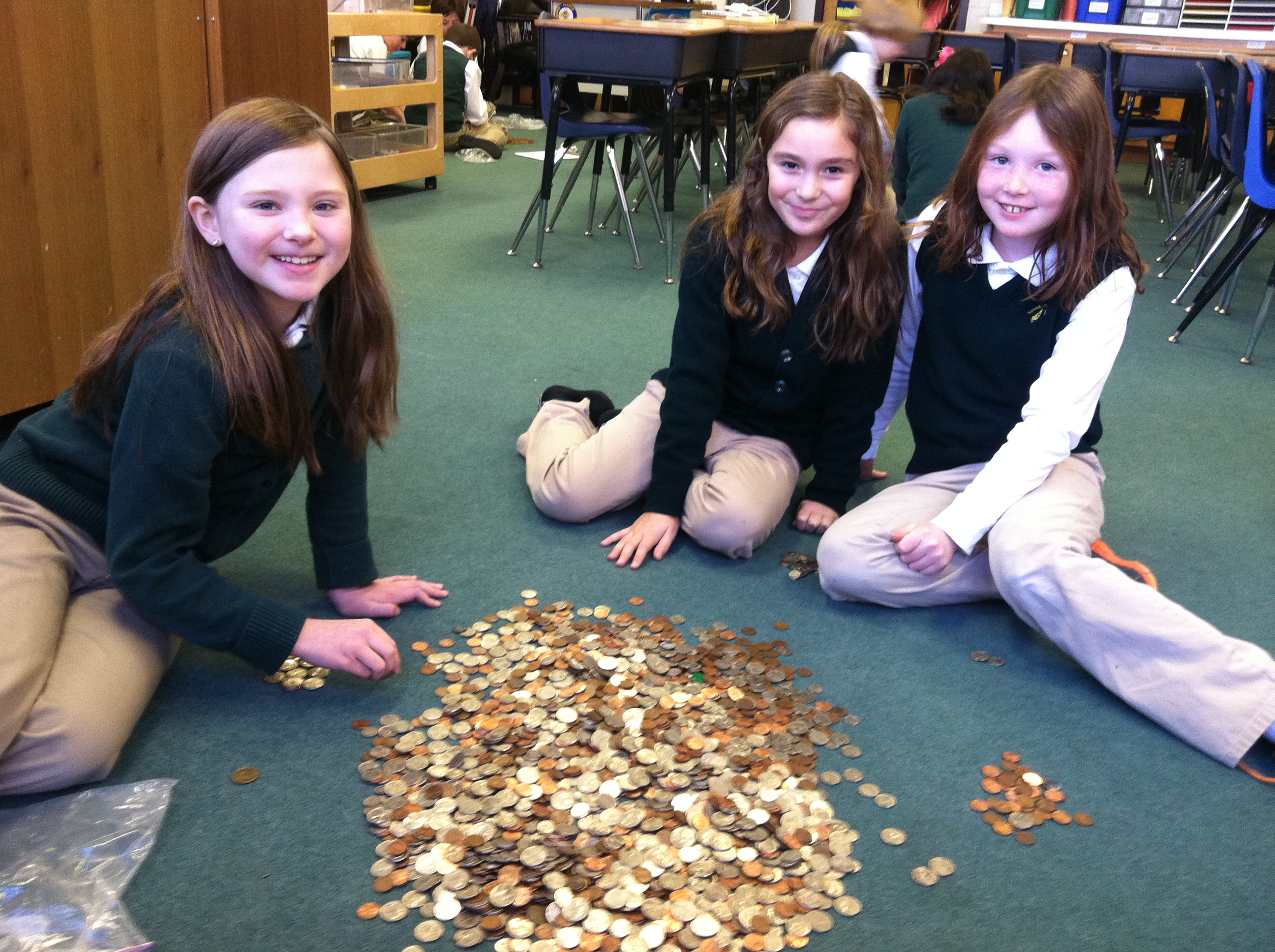
Paris, Mirai, & Raquel

Paris, Mirai, & Raquel

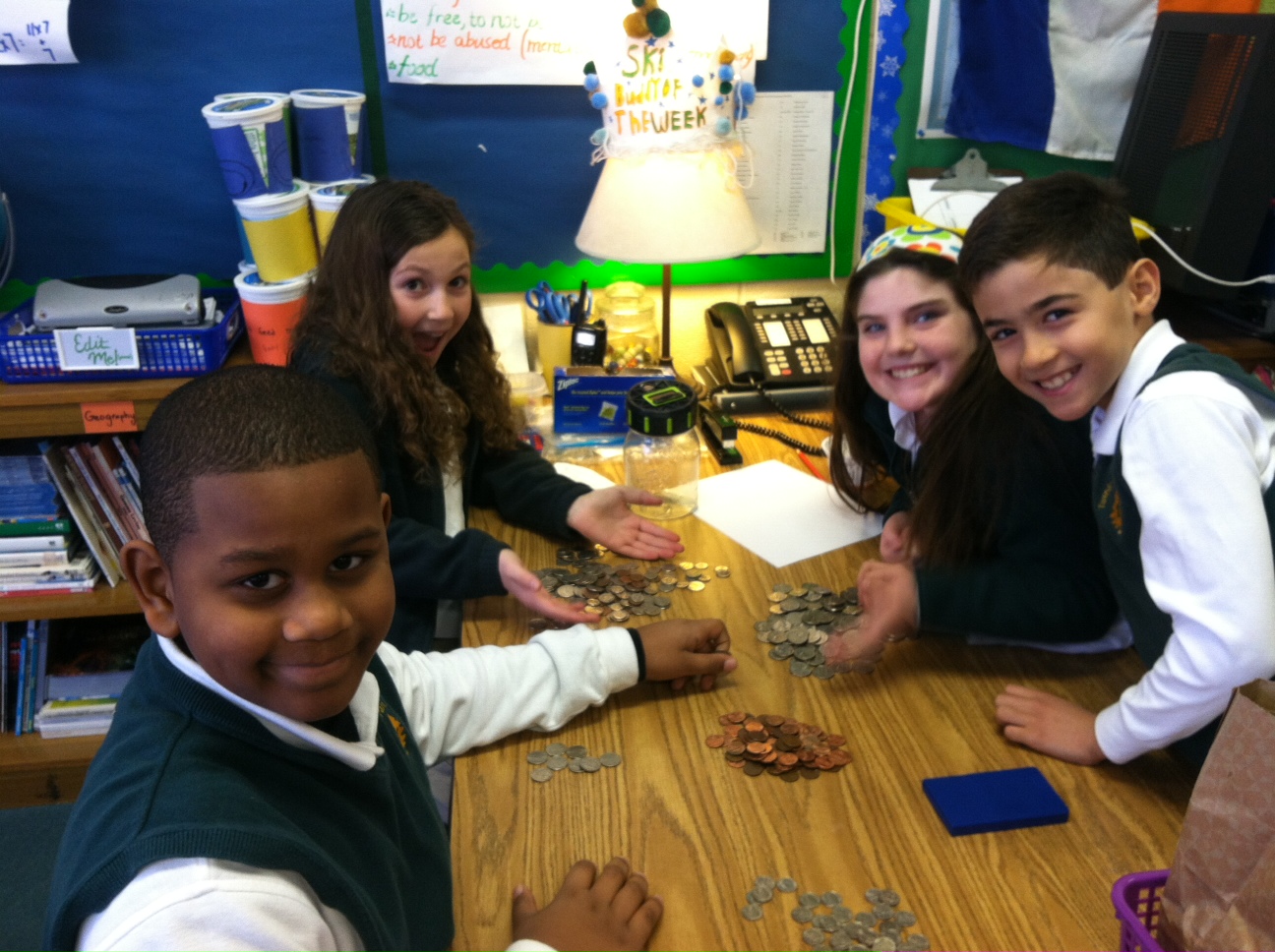
Two weeks ago third graders spent nearly three hours counting all the coins they collected from their change drive during the week of January 14-18. The classroom floor was strewn with pennies, nickels, dimes, and quarters as students worked in groups to count, record, and compute the amount of money they collected. As a result of their tireless perseverance in sorting and calculating coins children walked away with a deep appreciation for just how impressive their final total was, coming in at $1,351.52.

All the money raised will go towards purchasing books for the school in Mablomong, South Africa that Tuxedo Park resident Sue Heywood and the organization CarryYou are connected with. Third graders will each select a different loved picture book for our connection in South Africa to purchase. They will be able to send letters and illustrations to their peers in Mablomong about themselves and their reasons for selecting each book. The remainder of the money will be used to purchase a variety of books in English, Afrikaans, and other local tribal languages to fill out the collection at the school.

Third graders are featured in a local paper (The Photo News) highlighting their project and what they believed they learned from the experience. I encourage you all to read as their insights into themselves and the world are profound.

Justin, Megan, Courtney, & Serdar

Justin, Megan, Courtney, & Serdar

As their teacher, watching this project grow and develop from the seeds of their inspiration, I have marveled at what children can think, create, and do when given a safe environment, a thoughtful framework (though admittedly one I was making up as I went), and appropriate freedom. I have watched them grow in the incredibly crucial skills of collaboration, critical thinking, creativity, communication, & cultural competency as they worked together to solve problems, construct plans, implement them, and remain focused on their purpose. We had the opportunity to talk about topics of leadership & followership, children’s rights, multiple intelligences, and the diversity of talents and skills in our classroom community. We talked daily about the importance of making decisions around and remaining anchored by their “why”, their reason for pursuing this coin drive in the first place. When I initially asked the question back in December: “WHY do we want to collect money to buy children at this school in South Africa books?”

Student responses generated this collaborative “mission statement”:

 “People deserve an education. It is a child’s right to learn. In order to learn, people need books. We have so much and should share what we have. This gives children everywhere a better chance at a better life.”

Their relentless belief that these words mattered, and their perseverance in keeping their mission at the center through conflicts, presentations, planning, creating, and collecting is what ensured the success of their endeavor. From the beginning of this project the interest, framework, and implementation was student driven and as

a result they have acquired skills that will not fade (like the memorization of state capitals) because they were skills that were needed, honed, tested, and found necessary and useful. They know the challenges, triumphs, and hallmarks of good leaders and good followers (both of which are necessary for team dreams to become reality). They have greater appreciation for the diversity of what each member of their community brings to the table. They have the skills to resolve conflicts when they arise (as they inevitably do) in collaborative ventures. They have a deeper, richer global awareness and sense of citizenship in a world beyond themselves. Most invaluably: they have a stronger belief that they can make an impact…and the courage to act and make it real. They know now, in a way they did not before, that they can count on themselves and each other to be a source of the kind of change that lasts longer than pennies.

Cassie, Sam, & Eva

Cassie, Sam, & Eva